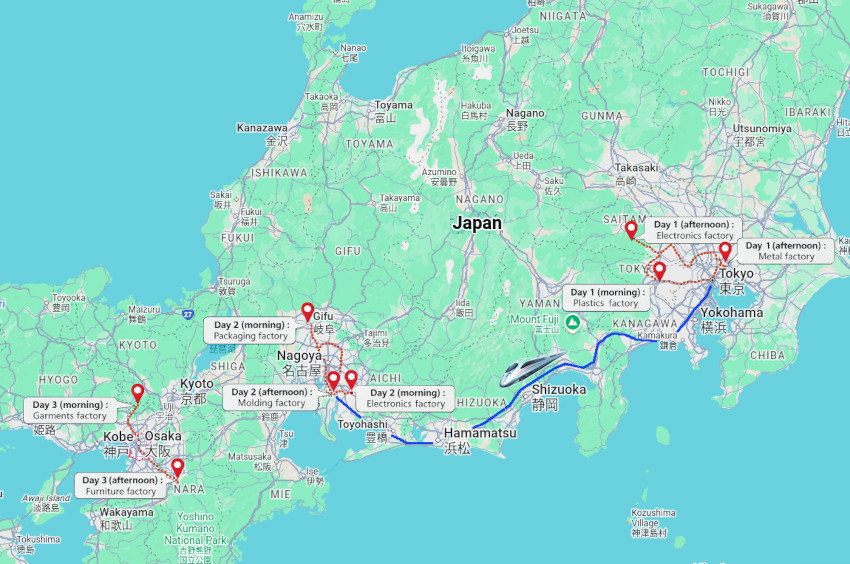
Curated, on-the-ground itineraries that combine your travel planning with serious supplier qualification, factory walkthroughs, and targeted visits across Japan’s most relevant industrial regions.
Japan is not a “cheap sourcing” destination—it is a reliability and engineering destination. A structured itinerary helps you meet the right suppliers, validate real capabilities, and leave with next steps you can execute immediately.
Japan is the benchmark for disciplined manufacturing: process stability, continuous improvement culture, and suppliers that take documentation seriously. A Japan sourcing trip is typically about validating engineering excellence, qualifying critical suppliers, and securing long-term reliability—not just comparing prices.
Many Japanese manufacturers communicate conservatively. You may not hear aggressive sales language—but you will see strong fundamentals: standardized work, visual management, calibrated measurement systems, and clear defect escalation. On-site visits let you verify process capability and understand where tolerances, materials, and testing truly sit.
Japan is particularly relevant when your project has “must-not-fail” requirements: tighter tolerances, high reliability, traceability, regulated environments, or complex assemblies where quality costs more than unit price.
For procurement teams, the goal is to reduce execution risk: fewer surprises in sampling, fewer uncontrolled changes, and fewer supply disruptions when volumes ramp.
A strong Japan program is not random factory hopping. It blends supplier identification, technical screening, factory walkthroughs, and decision-ready meetings into one itinerary. You validate what is made in-house, what is outsourced, and how quality responsibilities are managed across tiers.
In Japan, the difference between suppliers often shows up in details: measurement systems, change-control, CAPA maturity, document discipline, and the supplier’s ability to communicate engineering constraints clearly (and early).
The output should be actionable: a ranked shortlist, key risks and constraints, and a path to RFQ, sampling, and production readiness.
Japan works best when you arrive with a clear objective: qualify one critical supplier, validate a process (precision machining, tooling, surface treatment, electronics/inspection), or find a high-reliability partner for long product lifecycles.
The practical reality: fewer visits per day, more depth per visit. Meetings often involve engineering, QA, and production teams. Done well, you leave with aligned next steps and fewer “unknowns” in your supply chain decision.
Japan’s manufacturing strength is distributed across specialized regions. A sourcing trip is more efficient when it is built around these corridors—so you visit the right suppliers, in the right ecosystem, for your specific category.
Greater Tokyo is not only the business center—it is also a strong region for advanced manufacturing services, engineering partners, electronics ecosystems, and specialized component suppliers. It’s useful when your trip involves prototyping-to-production workflows, supplier headquarters meetings, or high-value technical discussions.
The Nagoya area is a core manufacturing corridor, anchored by automotive and a dense network of precision suppliers. This region is often relevant for precision machining, castings, forging, stamped parts, tooling, and industrial components—where process stability and quality systems are critical.
Kansai is known for a broad industrial footprint: machinery, components, factory equipment ecosystems, and specialized manufacturing. Depending on category, it can be a practical region for automation-related components, industrial assemblies, and specialized subcontracting networks.
Kyushu is frequently considered for electronics-related supply chains and high-tech ecosystems, including semiconductor support industries. If your category is electronics, inspection, or high-precision manufacturing, Kyushu can be a strong complement to Tokyo and Chubu.
Japan is typically selected when the priority is reliability, engineering depth, and process control. Common categories include precision components, tooling and mold-making, specialized materials and surface treatment, automation-related components, and high-reliability electronics and sub-assemblies. It can also be a strong destination for prototypes, pilot runs, and long lifecycle products.
If your objective is “lowest unit cost,” Japan is rarely the best fit. If your objective is “lowest total risk,” Japan is often one of the strongest options.
Japan is highly structured for business—yet factory access and productive meetings depend on preparation. To make the trip worthwhile, align early on technical scope, decision criteria, and what “proof” you need to see on-site.
Many Japanese suppliers communicate in a precise, engineering-first style. Meetings go best when you bring clear inputs: drawings, specs, acceptance criteria, target applications, and realistic forecast ranges. If your spec is unclear, the meeting will remain generic—and you may lose momentum after you fly home.
Bilingual support is often helpful for factory-floor discussions and deeper technical topics. Even when English is used, nuance can matter for tolerances, testing methods, and change-control expectations.
Japan rewards planning. Many factories require advance scheduling and may limit photography, line access, or disclosure depending on customer confidentiality. A structured itinerary anticipates this and ensures the meetings still deliver: process walkthrough, QA evidence review, and clear next steps.
A common cadence is one to two meaningful visits per day—because meetings can be longer, more technical, and include multiple stakeholders.
Japanese suppliers often prioritize stable relationships and realistic execution. They may push back if requirements are risky, timelines are unrealistic, or specs are incomplete. This is not a downside—it is often the exact behavior you want from a high-reliability supplier.
The best trips set clear checkpoints: NDA, RFQ package, sampling plan, inspection criteria, and communication cadence for engineering changes and approvals.
A productive Japan trip blends appointment setting, technical preparation, and the ability to run consistent qualification meetings across multiple suppliers. In Japan, the ability to prepare the right documentation and translate engineering intent matters as much as logistics.
MTA supports buyers who want to place Japan within a broader sourcing strategy: what Japan does best, where it is a better fit than alternatives, and how to combine Japan suppliers with other Asian production footprints when cost or scale is a constraint.
FVSource is best suited for teams that already have a defined project and want to turn a trip into supplier onboarding: pre-screened shortlists, structured visit agendas, and clear follow-up actions after the visit (RFQ, samples, QC plan).
For precision and regulated categories, a local specialist can add value by aligning on terminology, quality expectations, and documentation requirements—so you do not lose time or misinterpret constraints during the factory visit.
Start with your intent: exploration vs. qualification. If you are exploring, prioritize market mapping and cluster guidance. If you are qualifying and onboarding, prioritize partners that can prepare technical packs, run consistent checklists, and manage follow-up to sampling and production readiness.
A Japan trip works best as part of a short sequence: shortlist suppliers, validate constraints, visit the right regions, and move straight into RFQ and sampling with clear checkpoints. The goal is to gain certainty—fast—without burning time on suppliers that cannot truly meet your requirements.
Japan has dense supplier ecosystems, but specialization matters. A good approach is to filter by process capability (machining, tooling, heat treatment, testing), quality system maturity, and communication discipline—then build an itinerary around the regions where those suppliers cluster.
In Japan, pre-qualification saves time because factory meetings are typically structured and technical. Validate the basics early: process list, equipment, certifications, sample references, typical lead times, and the supplier’s comfort with your documentation expectations (drawings, revisions, approvals).
Technical package: drawings, tolerances, material standards, surface finish requirements, inspection plan, and examples of acceptable/non-acceptable results.
Commercial inputs: target volumes, forecast ranges, Incoterms, and your expected project timeline.
Qualification checklist: in-house vs outsourced steps, measurement capability, traceability, change-control, CAPA discipline, and lead-time control.
The trip should end with a structured output: a ranked shortlist, constraints and risks per supplier, and a sampling plan with owners and deadlines. That is what converts supplier visits into procurement progress after you return.