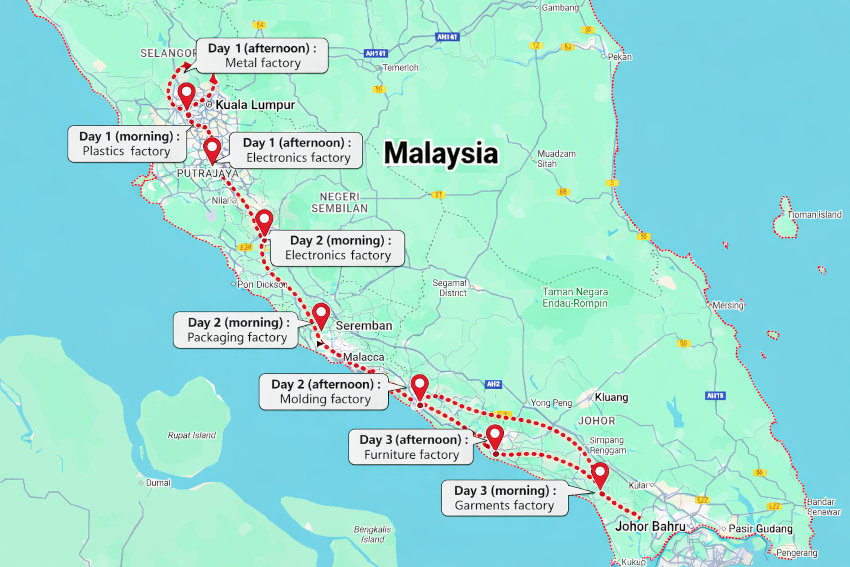
Curated, on-the-ground itineraries that combine your flights and hotel bookings with serious supplier qualification, factory audits, and targeted visits across Malaysia’s most relevant industrial clusters.
Book your sourcing trip today and get the best out of every business visit in Malaysia: clear factory shortlists, structured audits, and faster supplier decisions—without wasting days on the wrong industrial parks.
Calls, catalogs, and online profiles can start the conversation, but they won’t show you how a factory actually controls quality, manages sub-suppliers, or handles a production spike. A Malaysia sourcing trip lets you verify capabilities on the floor, meet decision-makers, and benchmark multiple suppliers within the same cluster—so you return with a shortlist you can move forward with.
Many Malaysian suppliers are experienced exporters with strong documentation habits and structured operations— but capability still varies significantly between companies. On-site visits reveal the basics that matter: how incoming materials are controlled, whether work instructions exist at the line, how rework is handled, and whether management can explain process limits clearly.
In Malaysia, you’ll often find factories with mature ISO-style systems, specialized subcontracting networks, and a workforce used to serving global customers. A tour helps you distinguish between “good presentations” and genuine process control—especially for regulated or higher-precision categories.
For procurement teams, this validation reduces the risk of onboarding a supplier that looks strong on paper but struggles with consistency, communication cadence, or lead-time discipline once orders start.
The best trips are planned around your product category and the right industrial corridors—not around a long list of random addresses. A solid program blends supplier mapping, factory audits, and commercial meetings into one itinerary: you validate process capability, review compliance documentation, and confirm what is truly made in-house versus outsourced.
Malaysia is particularly good when you need clarity on the “full chain” (tiers, sub-vendors, finishing, testing, packaging) because many suppliers work within established ecosystems—especially around Klang Valley, Penang, and Johor. Your on-the-ground team can benchmark factories consistently across the same checklist and translate what you see into practical next steps.
The result: fewer surprises after the trip and a clearer path to sampling, supplier onboarding, and controlled ramp-up.
Malaysia works best when you arrive with a clear objective: qualify two suppliers for a category, identify a backup source, validate a process (machining, EMS, injection, packaging), or explore a “China+1” strategy that favors stability and documentation.
A typical week is designed to reduce downtime: cluster visits during the day, short debrief sessions in the car, and a structured summary each evening. Instead of leaving with scattered notes, you leave with a ranked shortlist, key risks flagged, and an execution plan for samples and POs.
Malaysia’s strength is not “one big cluster”—it’s several specialized corridors that serve different industries. A sourcing trip becomes far more efficient when it’s built around these zones: Klang Valley for broad industrial coverage, Penang for electronics and precision, and Johor for cross-border supply chains and heavy manufacturing.
The Klang Valley (Greater Kuala Lumpur + Selangor) is often the starting point because it offers the widest mix: metal fabrication, machining, plastic injection, packaging, contract manufacturing, and a strong vendor ecosystem for finishing and logistics. It’s ideal if you want to benchmark options quickly across multiple categories.
Many buyers use Klang Valley to validate capabilities for industrial parts and assemblies—where stable quality, reliable lead times, and clear paperwork matter as much as pricing.
Penang is a go-to destination for electronics-related supply chains, EMS, precision machining, tooling, and higher-value manufacturing. If your trip involves components that require tighter process control (traceability, testing, documentation), Penang often offers a strong baseline and experienced project managers.
It’s also a practical stop if you want to evaluate suppliers that operate in structured environments and can support advanced requirements such as inspections, test reports, and robust change management.
Johor’s proximity to Singapore makes it an attractive corridor for companies that manage regional operations. Depending on your category, Johor can be relevant for heavier industrial work, equipment-related supply chains, and suppliers that serve both Malaysian and Singapore-based customers.
For teams already in Singapore, Johor can also be an efficient extension—especially if your goal is to compare suppliers across a wider regional footprint.
The right category depends on your spec and target cost—but Malaysia is frequently considered for: electronics/EMS, precision machining, industrial plastics, packaging, and industrial assemblies. Many buyers also appreciate the availability of supporting services (testing, certification pathways, structured quality systems) in established supplier networks.
Malaysia is straightforward for business travel, but a good sourcing trip still depends on preparation: aligning on technical scope, planning cluster routes, and knowing what “proof” to request at each factory. A little structure up front saves days of lost time on the ground.
English is widely used in Malaysian business environments, especially in export-oriented sectors. That said, technical precision is still the main risk: assumptions around tolerances, material equivalents, test methods, or assembly responsibility can derail projects later if not clarified during the visit.
Bring visuals: drawings, reference samples, defect examples, packaging requirements, and a short list of “must-not-miss” questions. Clear inputs make meetings faster and reduce ambiguity when you request quotations and samples.
The travel experience depends heavily on where your suppliers are located. A well-built itinerary avoids zig-zag commuting between distant industrial parks. It groups visits by corridor (e.g., Selangor days, Penang days, Johor days) and keeps enough time per factory for meaningful Q&A and a proper walk-through.
A practical rhythm is two to three in-depth visits per day, with travel buffers and short debriefs. This gives you time to validate what is really made in-house, identify critical sub-suppliers, and align on next steps.
Many Malaysian suppliers are used to procurement processes that require documentation: certifications, SOPs, inspection records, and clear commercial terms. Use that to your advantage—request evidence early, agree on responsibilities (especially for outsourced steps), and confirm communication cadence once sampling starts.
A respectful but direct approach usually works well: clear scope, clear timelines, and clear decision checkpoints. That’s how your trip converts into actionable supplier onboarding instead of “nice meetings.”
A productive Malaysia trip blends travel logistics with local supplier knowledge, pre-qualification, and the ability to run consistent audits across multiple sites. The partners below differ in style—some are best for exploration, others for execution and follow-through.
MTA supports buyers who want to compare Malaysia with other Southeast Asian options and build a clear sourcing roadmap. Their tours are often designed to educate decision-makers quickly: what Malaysia does well, where it may be a better fit than alternatives, and which clusters match your category.
This is useful for founders and SMEs who want to avoid “random factory hopping” and start with a structured market view before choosing suppliers.
FVSource is best suited for teams that already have a project definition and want to turn a short trip into supplier onboarding. The approach is built around pre-screened suppliers, consistent audits, and daily decision-making summaries.
After the visit, the same team can help drive sampling, negotiate terms, and implement quality control and production follow-up—so the trip doesn’t end as soon as you fly home.
Depending on your category (electronics, precision machining, packaging, plastics), a focused local specialist can add a lot of value—especially when you need to validate processes, testing capabilities, and supplier ecosystems within one cluster.
Start with your intent: exploration vs. execution. If you are benchmarking the country and clusters, prioritize market mapping and strategic guidance. If you need to qualify suppliers and launch sampling fast, prioritize partners that can run audits, manage follow-up, and stay operational after the trip.
A Malaysia trip works best when it’s part of a simple sequence: shortlist suppliers, verify the basics, visit the right clusters, then move straight into sampling with clear checkpoints. The goal is to reduce uncertainty quickly—without burning time on visits that don’t match your specs.
Malaysia has a strong B2B ecosystem across industrial parks and sector networks. Even when you don’t attend an event, you can use cluster intelligence to narrow your scope: which corridor is most relevant, what supporting vendors exist, and which supplier types match your technical needs.
Your sourcing trip becomes significantly more efficient when you pre-screen suppliers based on process capability and not just product photos.
Online platforms can help identify potential suppliers, but they rarely show the real picture: what is done in-house, how capacity is allocated, and how stable the quality system is. Use online tools for discovery—then verify registration, location, and capability before you invest time in on-site visits.
A local team can validate the basics, remove weak options, and add relevant suppliers that don’t market aggressively online but perform well in practice.
Prepare like you would for a supplier qualification:
Technical package: drawings, materials, test requirements, packaging specs, and photos of good/bad examples so expectations are unmistakable.
Commercial inputs: target volumes, forecast ranges, Incoterms preferences, and your expected timeline for sampling and first orders.
Audit checklist: a repeatable set of questions to compare factories objectively (in-house processes, QC checkpoints, sub-suppliers, traceability, and lead-time controls).
The trip should end with a structured output: a ranked shortlist, risk notes per supplier, and a sampling plan with owners and deadlines. That’s what converts factory visits into procurement progress—and keeps internal stakeholders aligned after you return.